Friday, March 7, 2014

Stocks are two faced and one is a pathological liar

Catchy title, eh? Well, again, someone else invented it and I adopted it.

Summarizing the long article below, the author emphasizes that after many decades of doing work with stocks and valuations, he continues to be convinced that "Earnings Determine Market Value," or EDMV.

Now, the other "face," the pathological liar face, is "Emotions Determine Market Value." You see where this is headed. The stock market has long been a balance between fear and greed, bulls and bears, emotion and earnings. I won't change. You need to be aware of the forces and act accordingly.

What does this have to do with buying a business? You can invest in the stock market and let external forces determine some of the results. Or, you can couple your money with your efforts and multiply the results. The folks I work with are tired of others making money off their efforts and want to use that for their own benefit. Along the way, you get a whale of a lot of self-satisfaction.

Still, when buying a business, remember that the EDMV principle works here as well. You must have earnings, and the value of the assets is only a small part of the equation. In the extreme, an insurance agent has few assets--a desk, phone, transportation. The earnings are from his/her energy.

Sometimes assets are a liability. For instance, I currently have a client who sees how much the company has spent on accumulation of assets and believes the business should be worth what those cost over decades. That is NOT going to happen. The earnings produced by those assets create the value.

GROWTH

Just as with common stocks, growth influences price. If EDMV, then the future value of those earnings is factored in. For example, in the examples below, some stocks are priced at 11 times earnings (P/E Ratio) and some are valued at 25 times. The difference? The current assessment of the market as to the growth and sustainability of that growth. Plus some emotion!

YOUR BUSINESS

Your business or the one you will buy is valued similarly. But at a much lower P/E Ratio, and the "Earnings" need to be adjusted to factor out the legal and sometimes semi-legal things that business owners may do to reduce their tax burden.

Successful businesses pay a lot of taxes, but Supreme Court Justice Learned Hand ruled long ago that none of us are obligated to pay more than our legal share. Sometimes, the rules are shaded to be more than was intended, and that is where I come in to adjust those earnings.

At the end of the day, you must know how much the business earns that is then available to pay you and the "bank."

NET OWNER BENEFIT (NOB)

Small businesses generally sell for multiples of one to four times NOB. Growth is a factor, size is a factor, but you must earn a salary and the "bank" should be paid whether the bank is an actual financial institution, your retirement plan or your savings account.

BACK TO EDMV

This gentleman has a valid point. When buying a business, practice this as well.

        
Stocks Are Two-Faced, And One Is A Pathological Liar
Summary
  • Both common sense and logic would dictate that future investment success and results are dependent upon possessing an accurate understanding of the most relevant factors that drive future stock movements.
  • In the long run - Earnings Determine Market Price.
  • In the short run - Emotions Determine Market Price.
Introduction
I believe that it behooves all investors that invest in common stocks to have a coherent understanding of what I consider the most important principle regarding investing in stocks. Moreover, a cogent awareness of this principle relates to having a relevant and valid answer to the following important question: What drives the future price of a common stock?
Both common sense and logic would dictate that future investment success and results are dependent upon possessing an accurate understanding of the most relevant factors that drive future stock movements and their direction - in the long run. Otherwise, how could an investor ever determine whether investing in a given company (common stock) makes sense, or if it represents an attractive investment opportunity?
Therefore, I offer this article as a dissertation on the primary factor that drives the future stock prices of a publicly traded common stock. Moreover, this same factor is the driver that creates the value of all businesses, public or private. In other words, with this article I am endeavoring to illuminate the primary principle that generates current and future value to business owners.
Admittedly, most of what I will be discussing I consider as "stating the obvious." However, as it is with many investing principles and financial jargon, the obvious is often overlooked or missed. More plainly stated, over my long career in the financial services industry, I have observed a penchant for making simple concepts complicated. In Western Pennsylvania, where I grew up, this was commonly referred to as "complicating a one-car funeral."
"It's the Earnings, Stupid"
With the above in mind, I respectfully ask the reader to allow me to state the obvious. It is simply the earnings power of any business that gives it value, past, present and future. The more earnings power a business possesses, the more value it is capable of delivering to its owners. Once again, this simple and obvious truth applies to every business, public or private. Consequently, if this is truth, and I contend that it is, then doesn't it make sense for investors in, and owners of, businesses to focus on earnings, first and foremost?
Frankly, I believe it does make sense for an owner of a business to focus primarily on the company's earnings power. However, my extensive experience in the investing industry suggests that most investors focus too much on price movements over profits. I believe this is a mistake, and yes, I believe it is an obvious mistake that can, and should, be avoided.
The 2 Faces of a Stock's (Business) Performance
I have long used the simple acronym - EDMP - to keep me focused on this important principle regarding the primary driver of a common stock's price. So much so, that I named the money management firm I co-founded based on it. The acronym EDMP stands for Earnings Determine Market Price (in the long run).
Fortunately for me, this principle was burned into my brain by my Economics professor in college. My professor's name was Alvin F. Terry, and every day, he started the investment course he taught in the following manner. Once we are all settled in our seats, Prof. Terry would walk up to his desk and literally and vigorously pound the table with his fists while shouting - EARNINGS DETERMINE MARKET PRICE! Every day, without fail, class was started with this fanatic ritual.
Needless to say, thanks to my passionate and enthusiastic professor, the obvious long-term driver of a common stock's price became forever imprinted into my psyche. In fact, his antics made such an impression upon my young mind, that it became the focal point of my life's work. My entire career, that now spans more than four decades, has been dedicated to validating Prof. Terry's thesis. Moreover, I am happy to report that my research and experience has proven to me that his simple and obvious hypothesis was both valid and true. Soon, I will present evidence supporting the truth behind my professor's words.
However, before I do that, I believe it's important to present and discuss a complicating factor that causes many investors to overlook the obvious. My research also uncovered that there is an evil twin sister - EDMP - that applies to the shorter run. Emotions Determine Market Price, in the short run, and it is this fact that creates the primary reason why investors often lose their focus and miss the obvious.
As human beings, we are emotional creatures, and when our emotions are in a heightened state, critical thinking goes out the window. This applies to all aspects of life, and certainly applies to how we handle or invest in our stock portfolios. In other words, in the short run, it is easy to become blinded by the two most powerful emotions that investors are often forced to deal with - fear and greed. Of the two, I believe that fear is both the most dangerous and most powerful emotion that investors must deal with. Fear is associated with anxiety, and when we are frightened, we are most likely to cast reason aside.
What this all boils down to is the reality that there are two faces of performance. To me, the true and most important performance face of a business is its operating performance. This is most commonly evaluated based on a company's bottom line, i.e. its earnings. Consequently, since I'm a long-term investor, I have also trained myself to pay more attention to the business behind the stocks I own, and less attention to the daily gyrations of their short-term stock prices in an auction marketplace.
Unfortunately, this is apparently difficult, or as I stated earlier, overlooked by many, if not most, investors. Instead of trusting their company's bottom line, they instead either obsess or worry about their investment based on whether the price of their stock is going up or down. And as I stated many times before, if the price of a company's stock is falling, it's a bad stock. In contrast, if the price of a stock they own is rising, it's a good stock. But most pertinent is the actuality that these judgments are often made with no informed regard to the fiscal health and strength of the underlying businesses they own.
The problem with this kind of emotional behavior is that all too often it motivates people to buy a stock they should be selling, and sell a stock they should be buying. A great company's stock price falls, and instead of recognizing it as the opportunity it is, they panic and sell. This often results in selling a valuable asset for significantly less than it is truly worth. This behavior caused more people to lose money during the Great Recession, than the Great Recession itself. Personally, I believe it's virtually always a bad idea to sell a valuable asset for less than its intrinsic value just because you are scared by the temporary actions or behaviors of others.
Real-world Examples of the Importance of Earnings
As I previously mentioned, my finance professor's passionate teachings inspired me to dedicate my life to evaluating his common sense thesis. However, with the investment world almost universally focused on stock price movements, I was frustrated at almost every turn as I looked for evidence to support the logical notion that earnings determine market price. Therefore, I took matters into my own hands and developed F.A.S.T. Graphs™, the earnings and price-correlated, fundamentals-based stock research tool.
Once armed with my creation, I was empowered to examine the long-term earnings and price correlation, and I now contend functional relationship on thousands of companies over many decades. The evidence supporting the importance of earnings is both overwhelming and incontrovertible. No matter whether earnings go, up, down or sideways, on graph after graph, earnings and price will move in tandem. Moreover, if the stock price strays away from its earnings-justified valuation (over or under), inevitably it will come back into alignment with earnings. Therefore, not only is this a common sense hypothesis, it is supported by a preponderance of undeniable real-world evidence.
Since a picture is worth a thousand words, I will offer the following examples via the F.A.S.T. Graphs™ research tool to illustrate the veracity of what I have thus far written. Importantly, the reader should note that the focus of the following exercise is on the long-term relationship between earnings and stock price. Consequently, even though some of the following examples do pay dividends, they will be excluded from the following presentation. More clearly stated, this is not a total return exercise, instead it is an exercise to illustrate that in the long run, earnings drive stock prices and trump price volatility.
(Note: In all examples, where possible, I will present my maximum 20-calendar year graphs. On any graph over 15 calendar years, only every other year's data is typed onto the graph, but all data is plotted.)
International Business Machines (IBM)
International Business Machines Corporation provides integrated solutions, such as consulting, delivery, and implementation services; enterprise software; systems; and financing for clients.
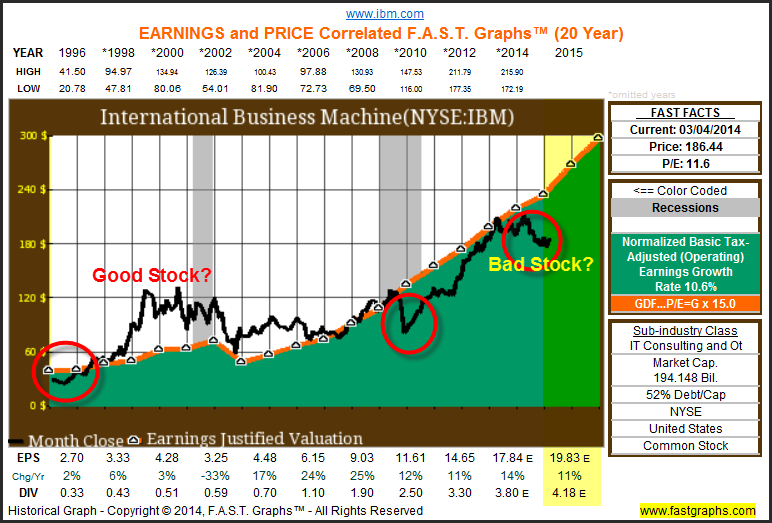
I chose IBM as my first illustration, because I feel it represents a quintessential example, or poster child for the good stock when prices are rising and bad stock when prices are falling notion. With the first IBM graph, I plot earnings per share since 1996, to include estimates for 2014 and 2015.
Clearly, IBM has been an earnings powerhouse over that time frame, with the only exception being 2002. To reiterate and focus on my thesis, the first face of IBM's performance, earnings, present a true picture of this company's valuation. Earnings have grown at an average annual compound rate of 10.6%.
(click to enlarge)
Interestingly, IBM has recently been a much-maligned company, as evidenced by many recent articles published here on Seeking Alpha. Simply search with its ticker symbol, and you will find many recent examples of negative articles on this blue-chip technology company. Therefore, we see evidence supporting IBM as a bad stock based on its poor stock price performance over the last two years or so. Ergo, price-wise, IBM bad stock, bad stock.
In contrast, this is in spite of the fact that the company's earnings have remained solidly in an uptrend, and are expected to continue advancing over the next several years by the consensus of analysts following the company (yellow highlights). However, a quick review of the earnings and price-correlated graph below illustrates that IBM's stock price has followed earnings over the long run.
Moreover, we see clear evidence that the best time to purchase IBM was during those times when its stock price fell below its earnings-justified level. In other words, when many investors thought it was a bad stock because its stock price was down. We see that in the beginning of 1996, again at the end of 2008 (The Great Recession), and once again today. These are times when the evil twin sister, EDMP (Emotions Determine Market Price-in the short run) dominates investors' minds. On the other hand, we simultaneously see evidence supporting the true performance generator, EDMP (Earnings Determine Market Price-in the long run).
(click to enlarge)
Bank of America (BAC)
Bank of America Corporation, a financial institution, offers a range of banking, investing, asset management, and other financial and risk management products and services to individual consumers, small- and middle-market businesses, institutional investors, large corporations, and governments.
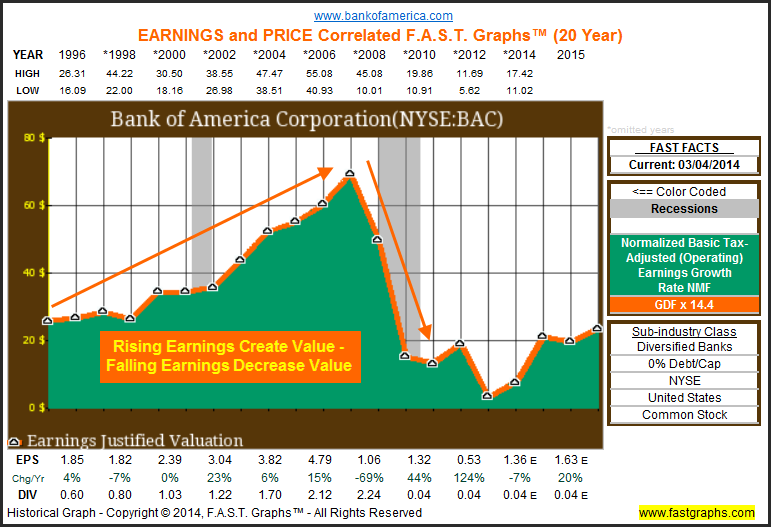
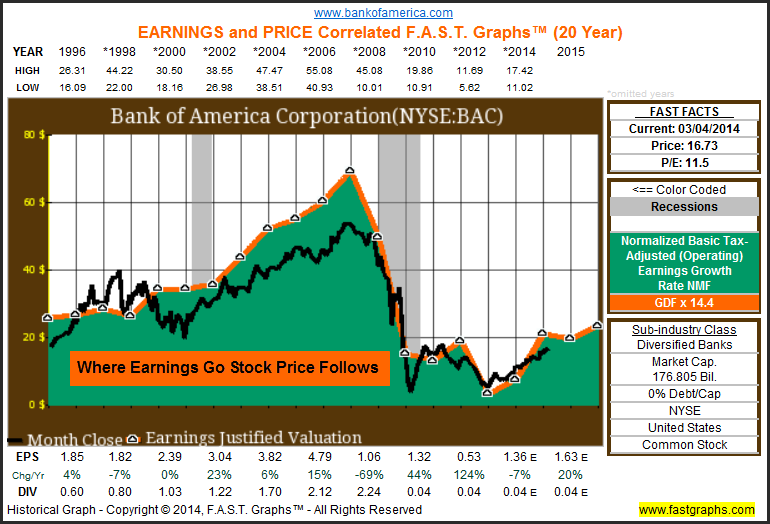
With my second example, I review the earnings history of Bank of America. I chose this example because it provides clear evidence not only of the importance of earnings, but also to the idea that where earnings go, stock price is sure to follow. With the first Bank of America graph, we see strong earnings growth for the first 11 years, followed by a collapse of earnings and somewhat erratic results thereafter.
(click to enlarge)
Consequently, when you overlay monthly closing stock prices to the earnings graph, the importance of earnings as a driver of stock price is clearly evident and undeniable. Where earnings went, stock price followed in the long run, up, down, and sideways.
(click to enlarge)
LKQ Corp. (LKQ)
LKQ Corporation provides replacement parts, components, and systems needed to repair cars and trucks. The company has operations in the United Kingdom, Canada, Mexico, and Central America.
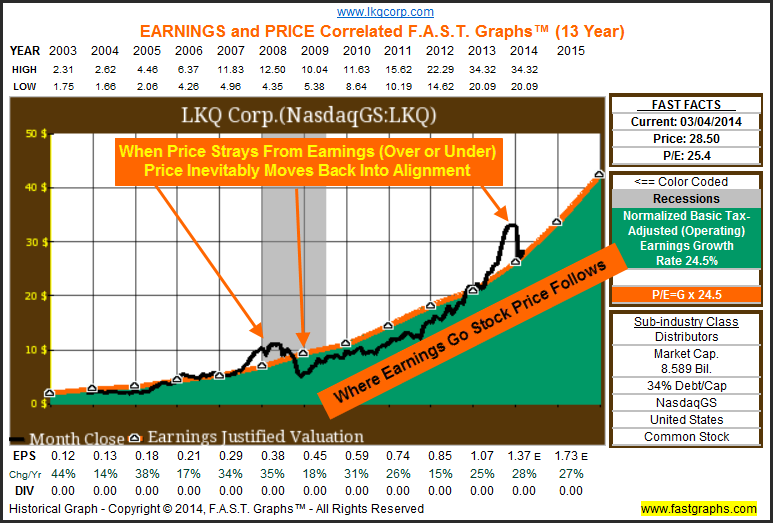
With my final example, I present LKQ Corp. as a quintessential example of a pure growth stock. Unlike my previous two examples, this company does not pay, and never has paid, a dividend. Therefore, the sole source of return that owners (shareholders) of this rapidly-growing business receive, or currently can expect to receive, is based purely on the company's earnings power.
I also chose this example because it has only been publicly traded since October 2003. Therefore, by looking at the horizontal EPS (earnings per share) column at the bottom of the graph, each year's earnings per share is both plotted and typed on to the graph. The earnings power of this company has been both exceptional and consistent, averaging 24.5% per annum since going public.
(click to enlarge)
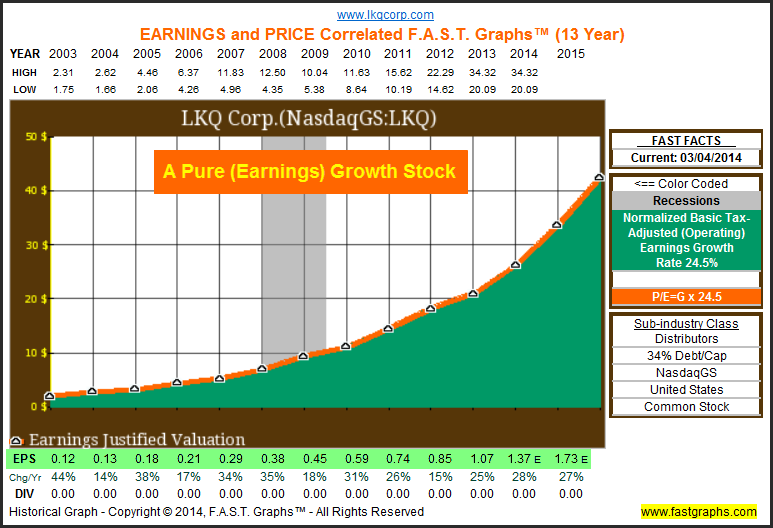
When we overlay monthly closing stock prices to LKQ's earnings, we discover as pure a long-term correlation between earnings and price as you will ever see. Moreover, we see evidence that when the company's stock price rose above earnings (the orange line), as it did in 2007 and 2008, that price soon came back to earnings. Once again, we see evidence supporting the idea that it's more important to focus on a company's earnings power over the long run than it is to focus on short-run price volatility.
The earnings power of a business is tangible and reasonably predictable. The investor can review important fundamentals, such as the balance sheet, profit margins, sales growth, etc., and derive a reasonable evaluation of the strength and health of the business behind the stock. In contrast, stock price volatility is ephemeral and often a pathological liar. In other words, price cannot always be trusted.
(click to enlarge)
The Moral to the Story
Serendipitously, Warren Buffett published his 2013 Letters to Berkshire Shareholders as I was preparing this article. What follows are a few excerpts of his letter that speak directly to the importance of focusing on long-term business results over short-run stock price volatility. These excerpts are based on the section of Warren's letter titled: Some Thoughts About Investing. Appropriately, he starts this section off with a quote by Benjamin Graham from his book The Intelligent Investor, as follows:
"Investment is most intelligent when it is most businesslike."
In order to illustrate the importance of thinking like a business owner, Warren utilized examples of two small non-stock investments he made in mid-1986 and 1993. One was a farm 50 miles north of Omaha, Nebraska that he purchased in 1986, and the other was a New York rental property adjacent to NYU that he made in 1993. He used these as focal points on why he believes that investors in common stocks should ignore price volatility. My first excerpt is as follows:
"With my two small investments, I thought only of what the properties would produce and cared not at all about their daily valuations. Games are won by players who focus on the playing field - not by those whose eyes are glued to the scoreboard. If you can enjoy Saturdays and Sundays without looking at stock prices, give it a try on weekdays."
Then, Warren Buffett goes on to say:
"There is one major difference between my two small investments and an investment in stocks. Stocks provide you minute-to-minute valuations for your holdings whereas I have yet to see a quotation for either my farm or the New York real estate."
Then, he goes on to put it all in perspective with the following rather extensive excerpt:
"It should be an enormous advantage for investors in stocks to have those wildly fluctuating valuations placed on their holdings - and for some investors, it is. After all, if a moody fellow with a farm bordering my property yelled out a price every day to me at which he would either buy my farm or sell me his - and those prices varied widely over short periods of time depending on his mental state - how in the world could I be other than benefited by his erratic behavior? If his daily shout-out was ridiculously low, and I had some spare cash, I would buy his farm. If the number he yelled was absurdly high, I could either sell to him or just go on farming. Owners of stocks, however, too often let the capricious and often irrational behavior of their fellow owners cause them to behave irrationally as well. Because there is so much chatter about markets, the economy, interest rates, price behavior of stocks, etc., some investors believe it is important to listen to pundits - and, worse yet, important to consider acting upon their comments.
Those people who can sit quietly for decades when they own a farm or apartment house too often become frenetic when they are exposed to a stream of stock quotations and accompanying commentators delivering an implied message of "Don't just sit there, do something." For these investors, liquidity is transformed from the unqualified benefit it should be to a curse.
A "flash crash" or some other extreme market fluctuation can't hurt an investor any more than an erratic and mouthy neighbor can hurt my farm investment. Indeed, tumbling markets can be helpful to the true investor if he has cash available when prices get far out of line with values. A climate of fear is your friend when investing; a euphoric world is your enemy."
Clearly, legendary investor Warren Buffett and his partner Charlie Munger understand the importance of focusing on the intrinsic value of the assets you invest in, while simultaneously eschewing short-term price volatility.
Summary and Conclusions
The performance of common stocks truly is two-faced. One face, the important one, represents the face of reason and focuses on the true driver of economic value to investors. The second face, is quite often a pathological liar, and for the most part, full of heightened emotion and simultaneously often devoid of logic. Yet somehow, and inexplicably to me, most investors are prone to trust the liar more than they do the face of truth and reason.
Judging your common stock investments based solely on whether the price has recently risen or fallen is madness. As Warren Buffett has tried to teach us for many years, it is wiser to invest in businesses than it is trying to time or play the market. These principles are especially important and relevant to those retired investors who are dependent upon the performance of their portfolios to support their livelihoods. Our futures and the futures of our families are simply too important to trust to hysteria and lies.
In conclusion, what I've written about in this article was solely focused on what drives the long-term stock prices of common stocks. Price action is only one component of total return, the other is dividend income. However, just as earnings drive long-term stock price performance, they are also the source of dividend income. Therefore, focusing on the earnings power of any publicly traded business you choose to invest in just seems like common sense action to me.

Monday, February 24, 2014

Moore's Law

Again, passing along information that I did not write, but find interesting:

Moore's Law comes to us from Gordon Moore, one of the founders of Fairchild Semiconductor (FCS) and, later, Intel Corporation (INTC). In a nutshell, Dr. Moore wrote a paper in 1965 describing his observation that the number of transistors on a given cost integrated circuit had doubled each year since the invention of the integrated circuit, and his belief that the number of transistors would continue to double, at the same cost, every two years for the foreseeable future. The subtle detail that is often missed in casual discussions of Moore's Law is that the number of transistors doubles AT THE SAME COST. So the size of a transistor has continually become smaller and less expensive.
This is almost unbelievable insight at a time where we were still four years away from landing on the moon, and we still didn't have the ubiquitous, and almost free, four function handheld electronic calculator.
Moore's Law (Moore's Observation) has been driving the progress in semiconductor technology for the past 50 years, and quite accurately, I might add. The feature size or "node" has been reduced from 10 um (micrometer) for the first commercial microprocessor (4004) to 14nm (nanometer) for the soon to be shipping Broadwell microprocessor. That is a 99.86% reduction in the size of a transistor. The 4004 had 2300 transistors and the Broadwell is expected to have about 1.6 billion transistors. That is almost 700,000 times more transistors than the first microprocessor!

The benefits we enjoy daily have been largely influenced by this miracle. But the subject of the article is that Moore's Law must come to an end.

We are about out of physics, here people. But the ride has been a good one. And this insight, as is mentioned, is truly amazing.

Monday, February 10, 2014

Search Intentionally


So, you want to purchase a business. You are tired of making money for someone else, time to work for yourself.
You have been searching the websites, BizBuySell and BizQuest for sure, and found some potentials, but nothing that quite measured up. 
In my opinion, and after doing this for 20 years, the search for a company to buy is better accomplished by doing it in an intentional, orderly way rather than just haphazardly thinking about what might be out there. A Planned Search. 
I perform these orderly, well-defined searches within the parameters that you set—with a money-back guarantee.  In writing.  All you have to do is tell me that you did not receive the work and the work product that you thought you would receive (we have to agree that I will not be able to find you a company that will pay you a million dollars for an investment of a couple of bucks!) and I will give you your money back.  It costs $5,000 and I spend virtually all that on mailings (my “secret sauce”), in getting the right lists and then massaging the lists to find what we are really looking for.

I have only had one client ask for the money back—I was just starting the campaign for a client in Detroit.  He had experience as a mechanic, knew the trucking business, and I knew of (and continue to know of) a business owned by a fellow who not only drove a truck but also recruited drivers with bad credit and sold them tractor-trailer units that he financed. This entrepreneur was in a special segment of trucking where he controlled all the money so that the driver/owner got a check every two weeks much like he was an employee, but built equity providing security for all parties. 
Sweet, sweet business.  Made a lot of money.  Anyway, before I even got started the fellow who wanted to look...took a job.  The more I talked to him, the more it was obvious that he was better suited to work for somebody than to own a business.  He just didn’t have the passion to succeed.

The second part of the arrangement involves my success fee. I charge a lower fee for a transaction that results from a Planned Search, and you pay me rather than the seller, unlike the more typical arrangement.  The reason for the lower percentage fee is that, in my experience, you will accomplish the purchase of a business if you have made an initial investment in finding one, so I am more likely to not be wasting my time. Because of the quantity of time spent, I only do one or two Planned Searches per year.
Having done this for years and years, I cannot tell you how much the whole business of "avoiding" a commission means to a seller!  They think they are avoiding the commission because you pay it, but of course that is not true.  You factor in the commission to the total price, finance it and the commission is there whether he pays or not.  I can’t prove this, but when you pay the commission, I work for you and I believe I get a much better price than if I were working for the seller. 
I talk about the “secret sauce,” but it is really that I have found a way to find people who want to sell but have not quite figured out how to do it yet.  It is sort of like getting the merchandize as it shows up on the loading dock, not after it has been on the shelf and picked over.

To point out the obvious, our efforts are more often rewarded when we know where we are going, when we plan and when we then execute the plan.

Friday, February 7, 2014

Resume


I would like to take credit for everything erudite and write wonderful stuff, but alas, not going to happen. I wish I could write better, but in order to make up for it a bit, I will publish the writings of others that I think fulfills a purpose on this blog. I try to give proper credit.
One of the most frequently repeated reasons for asking me to help you with buying a business, or entering into a Search process, is that you are tired of working your butt off making money for somebody else. Why not do it for yourself?
Here is a guy who wrote a resume but was an entrepreneur. Listen and learn, grasshopper...
This was posted April 9, 2012 by Marc Cendella, CEO and founder of “The Ladders.” 

Before he was famous, before he painted the Mona Lisa and the Last Supper, before he invented the helicopter, before he drew the most famous image of man, before he was all of these things, Leonardo da Vinci was an armorer, a weapons guy, a maker of things that go "boom".
And, like you, he had to put together a resume to get his next gig. So in 1482, at the age of 30, he wrote out a letter and a list of his capabilities and sent it off to Ludovico il Moro, Duke of Milan.
Here at TheLadders, we like to celebrate Leonardo's birthday — coming up next Sunday, April 15th — by sharing his wonderful resume with you. You can click on the image below to see the full-size version.
The translation of this letter is quite remarkable:
"Most Illustrious Lord, Having now sufficiently considered the specimens of all those who proclaim themselves skilled contrivers of instruments of war, and that the invention and operation of the said instruments are nothing different from those in common use: I shall endeavor, without prejudice to any one else, to explain myself to your Excellency, showing your Lordship my secret, and then offering them to your best pleasure and approbation to work with effect at opportune moments on all those things which, in part, shall be briefly noted below.

1. I have a sort of extremely light and strong bridges, adapted to be most easily carried, and with them you may pursue, and at any time flee from the enemy; and others, secure and indestructible by fire and battle, easy and convenient to lift and place. Also methods of burning and destroying those of the enemy.
2. I know how, when a place is besieged, to take the water out of the trenches, and make endless variety of bridges, and covered ways and ladders, and other machines pertaining to such expeditions.
3. If, by reason of the height of the banks, or the strength of the place and its position, it is impossible, when besieging a place, to avail oneself of the plan of bombardment, I have methods for destroying every rock or other fortress, even if it were founded on a rock, etc.
4. Again, I have kinds of mortars; most convenient and easy to carry; and with these I can fling small stones almost resembling a storm; and with the smoke of these cause great terror to the enemy, to his great detriment and confusion.
5. And if the fight should be at sea I have kinds of many machines most efficient for offense and defense; and vessels which will resist the attack of the largest guns and powder and fumes.
6. I have means by secret and tortuous mines and ways, made without noise, to reach a designated spot, even if it were needed to pass under a trench or a river.
7. I will make covered chariots, safe and unattackable, which, entering among the enemy with their artillery, there is no body of men so great but they would break them. And behind these, infantry could follow quite unhurt and without any hindrance.
8. In case of need I will make big guns, mortars, and light ordnance of fine and useful forms, out of the common type.
9. Where the operation of bombardment might fail, I would contrive catapults, mangonels, trabocchi, and other machines of marvellous efficacy and not in common use. And in short, according to the variety of cases, I can contrive various and endless means of offense and defense.
10. In times of peace I believe I can give perfect satisfaction and to the equal of any other in architecture and the composition of buildings public and private; and in guiding water from one place to another.
11. I can carry out sculpture in marble, bronze, or clay, and also I can do in painting whatever may be done, as well as any other, be he who he may.
Again, the bronze horse may be taken in hand, which is to be to the immortal glory and eternal honor of the prince your father of happy memory, and of the illustrious house of Sforza.
And if any of the above-named things seem to anyone to be impossible or not feasible, I am most ready to make the experiment in your park, or in whatever place may please your Excellency — to whom I comment myself with the utmost humility, etc."
What a fantastic piece of personal marketing! There's none of his famous backwards-mirror writing here — this letter was intended to be read and to persuade.

I'm a hopeless pedantic, so here's what I think we can learn from Leonardo's resume:

You'll notice he doesn't recite past achievements. He doesn't mention the painting of the altarpiece for the Chapel of St Bernard; he doesn't provide a laundry list of past bombs he's built; he doesn't cite his prior employment in artist Andrea di Cione's studio.

No, he does none of these things, because those would be about his achievements, not the Duke's needs.

Instead, he sells his prospective employer on what Leonardo can do for him.

Now imagine being the Duke of Milan and receiving this magnificent letter from the young prodigy of Florence. The specific descriptives paint a vivid picture of siege engines and bombardments and mortars and trench-draining and bridges to defeat the enemy. You can imagine the scenes that ran through the Duke's head as he held this letter in his hands and read through Leonardo da Vinci's bold statements of capabilities.

What Renaissance Duke wouldn't want "kinds of mortars; most convenient and easy to carry; [that] can fling small stones almost resembling a storm"? Sounds pretty enticing.

And that's exactly what your resume needs to do, too. Not the laundry list / standard bio that talks about you, but the marketing piece that talks about the benefits to your future employer and how you fit into his or her needs and desires.

So it turns out that even on his 560th birthday, this remarkable fellow Leonardo da Vinci is teaching us about the future. What a genius…

Wednesday, February 5, 2014

Your Self Interest and the Business Broker

This sounds Machiavellian, but it seems to me that people primarily act out of self interest. Yes, I will grant you that there are genuine acts of charity and self-sacrifice, but I did say "primarily." Just work with me here??

Take that one more step, and my "self interest" is best served when my interests parallel the interests of the other person. Extreme examples: during a mugging, it is in my best interest not to resist, to give them what they want and keep my mouth shut. That last part has always been a bit difficult for me. Your interest in surviving without too much damage parallels their self interest of not murdering you.

On the other hand, a typical example: partners (whether business or marriage) serve their own personal best interests by doing the things that need to be done in a manner that uses their own diverse talents even though some of those tasks may not be a lot of fun.

Enough about this philosophy stuff, what does this have to do with Business Brokerage? Simply this, that you will be best served when your business broker has an interest in the outcome that will be most favorable to you. How can this work when your financial interests are diametrically opposed to the Seller? He wants the highest price, you want the lowest price. Again, the intermediary has the interesting task of finding a "middle ground" that can be acceptable to both parties but allow for the transaction to actually move forward.

A good rule of thumb: when the Seller is not pleased and the Buyer is not pleased, you probably have a good deal.

Another clue is how the Broker/Intermediary is being reimbursed. It is quite common, and really good business for Brokers to charge a retainer. So much a month to do list the business, prepare the "book" and to develop potential buyers. This plus a commission or success fee when the transaction is accomplished. I know of a situation where the intermediary was paid $30,000 to prepare a "book," and it wasn't very good at that. Plus, they were to get the Lehman Formula for their efforts.

The Lehman Formula is the basis for most broker payments. Around for decades and named long before the Lehman Brothers failure, it provides for a fee of 5% of the sale price for the first $1 million, 4% for the second, 3%, 2% and 1% for anything over $4 million. Most Business Brokerage transactions are "double-Lehman," starting at 10% and ending at either 2% or 3%.

My listings are nearly always double-Lehman and I seldom charge a retainer except for a Listing Fee that ranges from $500 to $2,000 and has two purposes: one, to reimburse me for time and cash expended for preparing a valuation and for advertising; and, importantly, two, to determine if the Seller is actually serious. Without going into the reasons why people do what they do, suffice it to say that some Sellers will undertake a listing if it is free, disregarding the imposition that may cause on me. So, I impose that just to find out if they are serious.

With the double-Lehman, a business that is sold for $1,000,000 will owe me a success fee of $100,000 which, more often than not, I will share with another broker that brings the buyer. The broker pays for their own expenses and has a security interest to guarantee payment.

If I were advising a Seller, I would tell them to use an intermediary who practices pricing along those lines--virtually all the fees come from getting the job done, few if any fees come from up-front payments. There is little incentive to do the really hard work of working with buyers and sellers when you are sitting back collecting retainers.

Another caveat for the Parties is to make sure that the Brokers involved do not duplicate fees. If this happens, you will simply arrive at an impasse as the broker fees are so large that the deal is impractical.

So, self interest can guide you to a happy outcome. Align yourself with the interests of others and you get the best deal.

Contact me at 913.238.2298 or email at info@nbbcompany.com


Honey, I Just Talked to a Divorce Lawyer or How to Value a Construction Company


The other day, I walked into my wife's office and said, "Honey, I just talked to a divorce lawyer."

"Oh?" With raised eyebrows. Way to go, I had her attention!

"An old listing has asked me to provide a value for her construction company in a divorce case and I have agreed to do it." "Oh." The attention was fading.

Agreeing to provide a valuation, a deposition and testimony in court for a small fee and a potential listing did not raise my total worth in her eyes; and when I blurted it out, it didn't sound like a brilliant idea to me either.

Subjecting yourself to the humiliation and aggravation of interrogation by a lawyer set to make you look and sound incompetent should be avoided. So why do we do it? The only real reason: I know what a construction company is worth on the market, how difficult it is to find a buyer and close a transaction and I am offended by the highly paid, sublimely degreed imbeciles who compare the value of a construction company to a window manufacturing and installation business in Tampa.

The truth needs to be told. My wife, however, thought maybe someone else should tell it, and I should devote my efforts to something more productive and profitable. She had a point.

If you approach this from a mathematical viewpoint, develop averages, weighted averages and the like, the results are, in my opinion, flawed and extremely inaccurate. In this case, I thought the opinion of the opposing expert that the value was $750,000 was heinously wrong, but these types of valuations are appealing to the court because they do not require "judgment."

My opinion of value was $250,000 and I told her she would be lucky to get it. Especially since she was unwilling to provide a non-compete.

Here is what I subtracted from the "mathematical" viewpoint:
  1. The lack of a non-compete. In this very personal business, the cooperation of the Seller is critical, and, in this case absent.
  2. There was a back charge pending for over $300,000 and retainage exceeded $600,000. My valuation assumed (properly, I think) that only a fraction of these would be collected by a new owner.
  3. Backlog at the time of valuation was $300,000. Compared to annual revenue of $10 million, this was "full-stop." Based on historical margins, this would not pay overhead for a week.
Instead of a company that would perform along the lines of historical averages, I saw a company with uncertain performance, impaired assets and little evidence of future business.

WHY WOULD YOU BUY A CONSTRUCTION COMPANY?

Short answer: There is no better way to amass significant wealth. Except, of course, the two best ways - marry it or inherit it. Sure, I would like to reap the benefits of one of Warren Buffet's insurance companies, but I don't have a spare billion dollars or so. While contracting takes money, it is money that is often within the reach of individuals.

But this road to wealth is littered with the bodies of the vanquished, the ones who reached and failed. It is high reward and high risk.

A fundamental guideline: in my experience, it takes construction experience to be a qualified buyer of a construction business.

When establishing a value/making an offer to purchase:
  1. Keep the price within about 1.0 to 3.0 times cash flow. "Cash flow" is essentially Earnings Before Interest, Taxes, Depreciation and Amortization (EBITDA) plus owner salary, benefits and perks that were included in expenses. Sometimes, I describe it as the amount of money thrown off by the business after taking account the expenses justifiably needed to perform your service or deliver your product. Another way: the money left over to pay yourself and the bank, whether the bank is a loan or it is the amount you invested.
  2. Recognize the extra value of equipment, but the effect is probably not substantial in most except "heavy" contractors.
  3. Include a "look back" provision in your purchase contract as a way of settling up on matters that will be decided as jobs complete.
  4. Insist on a backlog that will provide a good start for the new owners.
  5. Obtain a meaningful transition process.
  6. In due diligence, look for general contractor back charges, establish a bonding line prior to closing and be very careful about the difference between what you thought you had been told by the owners and the broker and what you are seeing. Quiz current customers and any contractors you are a sub to.
PAY UP FOR QUALITY AND GROWTH. When considering the multiple of cash flow, move higher if the company is growing and fairly large, move lower if the company is small (your salary takes more of the "cash flow"). The term "quality" can mean a lot of different things, but make sure that you get a company that has some certainty to the future of the earnings stream although that is extremely hard to discern.

Buckle up, get ready for a ride! Good luck.

Contact me at 913.238.2298 or email at info@nbbcompany.com
 

I Have Never Fired Someone Too Early

Have you ever reviewed the dismissal of an employee in your mind and said, "Gosh, I wish I had not fired that person. I should have given him/her more time."

Well, that thought has never occurred to me. Instead, this is the way it usually goes: "Dang it, why did I wait so long?" Or something stronger.

The facts are that by the time you, the boss, figures it out, everyone else in the company knows and may be laughing at the way this employee gets away with stuff. You, my friend, are NOT the first to know.

After some time has passed, it is almost certain that more incidents or information will be revealed that indicate that the problem was deeper, more frequent and more serious than you thought when you fired the employee.

MY FRIEND LANCELOT

Well, his name is not Lancelot, but close, and that isn't the point of the story. L and his wife had come up through the trades and they ran a nice little business in the construction industry. Made a nice living, had a good crew and used their certification as a minority-owned business judiciously. They did good work and things were going well.


Until Mrs. L got cancer. It lingered for a long time, consumed L's time and energy and eventually Mrs. L's life. As she got weaker, she wasn't able to do the work at the company and they hired a friend from church, Marie, to help out. Marie became a permanent employee and things went along for a couple of years.

One day, a long-time supplier and friend saw L at a ground breaking on one of their mutual projects and said, "L, my man, I need to get paid on that invoice for this job." L was surprised and said he thought he had already paid it. No, better check.

Upon checking on things, it seems that Marie was not only Mrs. L's close friend from church, she was a gambler, had a big-time gambling problem and had embezzled almost $400,000 from this little company over a couple of years. It almost broke the company and, although she went to prison, the money was GONE!

Marie had intercepted all the calls, juggled the checks to keep the creditors at bay and didn't count on the chance meeting at an event. She would alter the checks that L signed so that she was the payee.

Lancelot survived, but he should have paid more attention, had more controls...and he certainly didn't fire her too soon.

STEALING TIME

This was, of course, an extreme case. More likely, it involves petty theft (one case I know involved buying supplies from a friend for a "premium" and splitting the proceeds) but MOST LIKELY, employee malfeasance involves stealing of another kind, stealing time. The employee is paid to do a job and just isn't doing it.

These kinds of situations are more difficult to ferret out and more difficult to bring to conclusion. Did I provide the correct instructions? Did I train the employee properly? Should there be a time that an employee should be able to work on "outside" jobs?

THE SECOND RULE

As well as "Never Too Early," the second rule is "Things are not very clear." You will always need to make these kinds of decisions with incomplete information, and for some supervisors, that kind of action is anathema. To make things worse, you will make mistakes.

I remember making one of those mistakes, and it almost cost me my job. The employee in question was shoved down my throat by my boss which started things off on a bad foot not improved by the actions of my boss and the employee to persist in going around me. The fact was, however, that she was not doing her job and even after extensive counseling, really didn't think she had to do the job because her benefactor would protect her.

Although I had documented the employee's ineffectiveness and insubordination and had it verified by others, although I had discussed the situation with my boss, I took action out of anger and that was the terrible mistake. As an excuse, I was fighting the flu and had a high fever at the time, but as you know...that's no excuse and there just aren't any.

DO IT RIGHT

You have enough information, it is well documented, you have gathered the approval of everyone else who needs to know. Now, just go ahead and perform your job.

Not getting rid of an employee who others know is not performing can have terrible consequences on the morale of the group and your reputation. They probably already know that you are not a hero, but they should not be encouraged to think of you as a milquetoast.

When you do your job, don't argue with the terminated employee. You are well past that. Good luck.